
#StPeterdanb
Walking with one another in faith and love.
#StPeterdanb

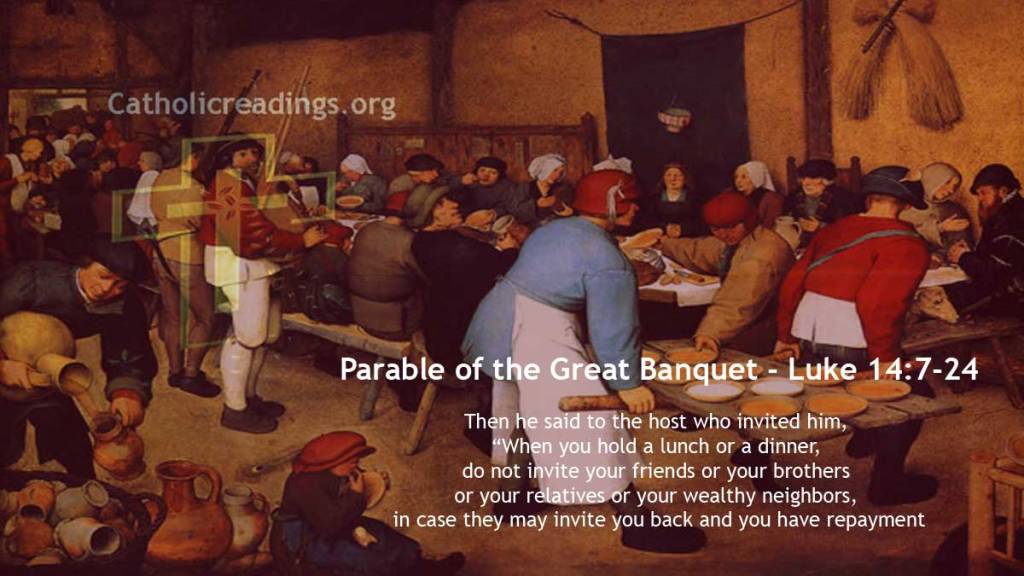
The months of November and December both have great feasts in them, namely, Thanksgiving and Christmas. I happened to hear a video of an excellent talk by a speaker at the summer NAPA conference this year about the importance of hospitality in human relations. The very next day I happened to read the Gospel for that day (November 6th) about the Parable of the Banquet in Lk 14. The meditation in Word Among Us that day was excellent. Not taking this as a mere coincidence, I include that fine meditation below.
Luke 14:12-14
When you hold a banquet, invite the poor. (Luke 14:13)
For Jesus, the dinner table is a sacred place. He often chose to make a personal connection with people by coming to eat at their homes. Because Jesus is present in the sacred meal of the Eucharist, heaven touches earth at every Mass. This holy encounter will continue into eternity in the “wedding feast of the Lamb” (Revelation 19:9).
But even ordinary mealtimes can provide opportunities to meet with God. From Abraham to Rahab to the first disciples, God’s people encountered their Lord by showing hospitality (Genesis 18; Joshua 2; Acts 2:44). Even more, they reflected the generous hospitality of God himself.
So when Jesus talks about holding a banquet and inviting the poor, he’s inviting us to be hospitable like his Father (Luke 14:13). He’s asking us to rework our guest lists and reorient our hearts. He’s asking us to open our arms to the suffering and marginalized and see them with his compassion. And he’s reminding us that people who are poor or suffering have great dignity.
Jesus is not just describing a meal offered, but a meal shared as family. We can truly encounter and connect with another person by welcoming them, by being present and listening, and by experiencing God’s love together. As we sit at such a table, walls begin to tumble. Sharing a meal communicates love in tangible ways that surpass words, and a stranger can become a brother or a sister.
We might not know how to “invite the poor” into our lives, but we can start by asking the Holy Spirit to show us someone who is hungry—whether for food or for an experience of God’s love. The Spirit can open our eyes and help us to reach out to them. People often have simple, ordinary needs. Even a smile or a few dollars or a kind word can open the door to the hospitality God wants us to show. As we talk with them, we may have an opportunity for a longer encounter—perhaps by getting a cup of coffee or inviting them to lunch. There, we will also encounter the God who lives within them. We can affirm the beauty and dignity he has breathed into their souls—and find Jesus himself.
“Lord, open my heart, my schedule, and my table today to someone who is poor or poor in spirit today.”
Romans 11:29-36
Psalm 69:30-31, 33-34, 36
@stpeterdanb
Bishop Caggiano of the Diocese of Bridgeport delivers an introduction of his vision of The One. This is the first in a series of ten. (4 min)
In this initial video, Bishop Caggiano gives an introduction to the vision he calls, The One.
Transcript
Auto-scroll
My dear friends, allow me to begin by offering my personal thanks to the two thousand, three hundred individuals who joined me for those nine initial regional meetings, which allowed me to introduce The One.
But since those days, many people in different venues have asked me, well, Bishop, what is The One?
And of course, it’s a question that may not have such an easy answer.
Because one could say it’s an initiative, and in some sense it is, because in the years ahead, we’re going to have an opportunity to offer events and programs and formational experiences, and those are very good. But The One is more than that.
It is certainly a change of culture. I mentioned that in my talks. The hope is, by all that we do together, the accumulated effects of our work will begin to change the culture of our church so that it will create an environment where every person who’s baptized can come to deeply know the Lord, and enter into discipleship for a lifetime, and go out in mission.
But The One is more than that.
And of course, I called it an adventure, and I do believe it is an adventure. Because it’s going to invite real change in your life and mine.
So what is The One?
Perhaps the best to describe it is for me to say: The One is the one invitation being offered to
you and me.
An invitation unlike any other invitation you and I have received.
It’s an invitation to ask with courage a basic question.
What is it that you are truly, deeply, personally looking for in your life?
And the person who’s asking that question needs to come face to face to the one who’s inviting you and me. And that is the Lord Jesus.
The One is really accepting the invitation of Christ, to come to know love, serve, and follow him in our daily lives, together as sisters and brothers united as his body in the world.
So the one invitation is what brings us together. It’s the one invitation that you and I need to make a personal choice about. It’s the one invitation that simply invites us to allow our lives to be transformed, to give us hope, and through us, to a whole broken and confused world. And of course, we’re not the first to be offered that invitation.
Each Easter, we hear the beautiful story of the two disciples on the road to Emmaus.
And in that moment, they were invited to allow Christ to enter into their lives.
And in the weeks ahead, together with these videos, we’re going to explore what that really meant, how that really changed them. Because the same can happen to you and me and to our entire church.
So what is The One?
It’s the invitation to take our lives and allow them to be transformed in Jesus Christ.
So the question I leave you with, are you and I willing to accept that one invitation?
@speterdanb
@igesaistpeter
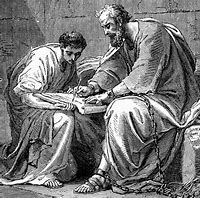
The readings on Monday, September 18th were St Paul’s letter to Timothy (1Tm 2:1-8) and the Healing of the Centurion’s Slave (Lk 7: 1-10). Both passages from Scripture talk about dealing with those that were despised by the Jews at the time, namely, the Romans. In Timothy, Paul encourages the people to pray for those in authority. In Luke, Jesus is speaking with the servants of a Roman centurion. The meditation in Word Among Us provides wonderful insights from these readings and is provided here.
MEDITATION
1 Timothy 2:1-8
I ask that supplications, prayers, petitions, and thanksgivings be offered for everyone, for kings and for all in authority. (1 Timothy 2:1-2)
Jane was frustrated with her boss and often complained about him to others. For as long as she had worked for him, he had never complimented her for her work or given her greater responsibility. One day, a friend suggested that she pray for her boss and ask God to bless him. Jane decided to give it a try, and as she did, she noticed that her attitude toward him began to change. What’s more, she saw an improvement in the way he related to her!
Jane’s experience highlights the same truth that St. Paul wrote to Timothy in today’s first reading: when we pray for others, especially for those in authority, it blesses us as well as them. Paul encouraged Timothy to tell the Christians in Ephesus to pray for everyone—not just other believers, but even for the leaders of the city, unbelievers who held authority over them. Doing so, Paul said, would help the young church to live a “quiet and tranquil life in all devotion and dignity” (1 Timothy 2:2).
When we complain or focus on what is wrong in the world, we can create an air of negativity, not only in our own hearts, but all around us. Without even realizing it, we can bring down our friends, family, or coworkers. But when we pray for people instead, our hearts change. We become more loving, patient, and kind toward them. As a result, our demeanor can help dispel any negativity that we might have brought to the people around us.
So who should we be praying for? If you’re a student, pray for your parents or teachers. If you have a job, pray for your supervisor and the leadership of your company. Pray for the leaders of your town, state, and nation. You don’t have to agree with them on everything—or anything! But you can still pray that God’s blessing and goodness would be upon them. You can still pray that they fulfill God’s purposes for their lives and that they lead as he intended. By doing so, you’re helping to fulfill those purposes. And in the process, you’re softening your own heart.
“Lord, the next time I want to complain about someone, help me to remember to pray for them instead!”
Psalm 28:2, 7-9
Luke 7:1-10
@Iglesiastpeter
@StPeterdanb
The past few Mass readings in the month of July have focused on the book of Exodus. Starting with the birth of Moses at a time when Pharoah of Egypt had decreed that all male children of the Israelites should be killed, we hear the story of how Moses’ mother put him in in a covered basket in the hope that the Lord would save him. Astonishingly, he was found and raised by Pharoah’s daughter. The next Mass reading continues the story. The publication, Word Among Us, wrote several excellent meditations about these readings and these will be shared in a series of posts here.
DAILY MEDITATION: EXODUS 3:1-6, 9-12 (Part 1)
Who am I that I should go to Pharaoh and lead the children of Israel out of Egypt? (Exodus 3:11)
The Scriptures are full of unlikely heroes. Jacob engaged in fraud and trickery to get what he wanted; David was as impulsive as he was zealous; Rahab was a prostitute and belonged to an enemy tribe; and Moses, whose story we begin today, was a murderer who struggled with a speech impediment. Each of these people seemed unfit to serve the Lord, yet each one ended up playing a profound role in salvation history.
While we may view these people as heroes of the faith, we should never forget where and who they were when the Lord first called them. They are proof that, again and again, God chooses people who seem the most unlikely and least equipped rather than the candidates we might be more inclined to select instead. And praise God that this is true! It means there is hope for each of us!
When we feel that the Lord might be calling us to a particular task or to a life of greater love or holiness, we may be tempted to echo Moses’ response: “Who am I” that God should use me (Exodus 3:11)? Like Moses, we might argue that our mistakes, weaknesses, or lack of experience makes us unfit for service. But this is precisely why God calls us! He delights in using ordinary people to accomplish his extraordinary plan. He chooses the foolish, the weak, and the obscure to carry out his will (1 Corinthians 1:27-28). Just look at the Virgin Mary: she considered herself among “the lowly,” and yet God chose her and lifted her up (Luke 1:52)!
God has a beautiful plan for your life. He invites you to share his goodness with the world. He will use your strengths, and even your weaknesses, to lead people closer to him. You don’t need to ask, “But who am I?” Instead, let the Spirit remind you: God has chosen you—and he always pours out grace on those he chooses! That means you can respond just as our Blessed Mother did: “May it be done to me according to your word” (Luke 1:38).
“Yes, Lord, I believe that you can work in and through me today.”
Psalm 103:1-4, 6-7
Matthew 11:25-27
@Iglesiastpeter
@StPeterdanb

https://www.ncregister.com/features/20-years-with-the-passion-of-the-christ
#stpeterdanbury1
#stedwardchurch
@strosenewtown
@stjospehdanbury
@stjosephbrookfield
@stgregortdanbury
@stmaryridgefield
@stmarybethel
In the Gospel reading on Saturday, April 1st, the day be for Palm Sunday, John’s gospel (Jn11:45-56) gives us the Session of the Sanhedrin. Many members are upset to hear about Jesus’ popularity among the people and that he will be entering Jerusalem. The High Priest, Caiaphas, makes a startling prophesy!
The publication, Word Among Us, provides a Daily Meditation on the Mass readings everyday and the one on April 1st was excellent and follows here.
Daily Meditation
To gather into one dispersed children of God. (John 11:52)
Tomorrow is Palm Sunday, when we will walk with our Lord through all the events of his passion and death. And today’s gospel gives us a perfect lens for viewing those events. When Caiaphas, the high Priest, told the Jewish leaders, “It is better for you the one man should die instead of the people,” he probably didn’t fully understand what he was saying (John 11:50). But John tells us that Caiaphas had prophesied: through his death, Jesus would “gather into one of the dispersed children of God” (11:52). In hindsight, we see that this is exactly what Jesus was doing: he was gathering all people to his Father.
When he entered Jerusalem, Jesus gathered his people to celebrate God’s closeness and acclaim his kingship (John 12:12-19). In doing this, he foreshadowed the celebration of heaven, when he will gather people from every nation to worship before the throne of God (Revelation 7:9-17)
When he celebrated the Passover, Jesus gathered his disciples to wash their feet and offered them his body and blood (John 13:1-20; Matthew 26:26-28). Even more, he commanded them to “do this in memory of me” (Luke 22:19). He made a way to gather all his future disciples as well – even us! We can rejoice together at the Eucharist and proclaim Jesus’ death until he returns (1Corinthians 11:26).
When Jesus accepted Pilate’s unjust condemnation (John 19:16), he gathered all sinners to himself. By offering himself on Calvary, he took upon himself every sin so that through him, every sinner can receive forgiveness (1Peter 2:24; John 3:16).
Finally, when the risen Jesus forgave Peter’s betrayal he reestablished him as the chief apostle, the one who would continue to gather believers in Jesus name (John 21: 15-19). The Lord never stops gathering his people to himself!
As you enter Holy Week, remember that Jesus is gathering you in. He is bringing you home to his Father and to your brothers and sisters in Christ. Let him draw you close. Receive his mercy and forgiveness and take your place in his family.
“Lord Jesus, get me into your family.”
#stpeterdanb
Your willingness to share your knowledge can make a huge difference for people!
5 minutes
#stpeterdanb
The Advent and Christmas seasons are always special times each year when Christians are anticipating the Coming of our Saviour and then celebrating the arrival of the Infant Jesus. We started earlier than usual and were actually able to get our preparations completed early this time! (Well, most of them anyhow). This gave us more time to enjoy our 17-month-old grandson who is a lot more active and aware (He is walking around everywhere now….).
During my prayer time, I always go over the Mass Readings for the day and the meditations from various sources. The plight and struggles of families to raise their children in the Faith has been a growing concern of mine for the past several years. When the Feast of the Holy Family came on December 30th, the readings of Sirach 3: 2-6 and 12-14 and Mt 2: 13-15 and 14-23 were powerful. In Sirach, he talked about how God sets the father and mother over their children and, in Matthew’s Gospel an angel of the Lord tells St Joseph to take the family and flee to Egypt to protect them.
A Meditation in the December 2022 issue of Word Among Us for Dec. 30th was very good and follows here for you to ponder the title of this piece.
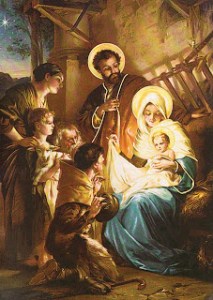
DAILY MEDITATION: SIRACH 3:2-6, 12-14
Take care of your father when he is old. (Sirach 3:12
Doesn’t today’s first reading paint a beautiful picture of family life? Parents eagerly welcome their newborn baby into their hearts and home. They take care of that child’s every need until she is able to live on her own. The child, in turn, honors and respects her parents, and when they grow old and become unable to care for themselves, she steps in and cares for them.
Of course, we know that it doesn’t always work out that way, often through no fault of our own. But we can still form the circle of love that God desires every time we follow his call to “take care” of one another (Sirach 3:12).
On this feast of the Holy Family, let’s consider what it means to take care of our loved ones. Of course, it starts with making sure that they are physically safe and healthy. But it goes far beyond that. “Taking care” means being aware of their feelings and paying attention to how our words and actions affect them. It means being patient when they are slow to learn or unable to do things for themselves. It means doing all we can to share our faith and enable them, whenever possible, to practice theirs. It means telling them how much we appreciate them. It means forbearing when they annoy us and forgiving them when they hurt us. And it means interceding for all their needs.
So take care of your children, your parents, your siblings. Take care of them when they are too young or too old to take care of themselves. Take care of them when they are ill or troubled. Take care of them when it’s a delight and when it’s a sacrifice.
This is a high calling, and we may fail at it sometimes. That’s all the more reason to ask Jesus, who experienced family life himself, for the grace to keep forming this circle of love-day by day, week by week, year by year. Let’s also ask Mary and Joseph to pray for us. May our care for one another bind us together in the Lord all the days of our lives!
“Father, thank you for the gift of my family. Help me to care for them as you care for me.”
Psalm 128:1-5
Matthew 21:13-15, 19-23
@StPeterDanb
#StPeterDanb
A very Merry and Blessed Christmas to all of you!

@stpeterdanbury
 Seeking Jesus in Danbury