The St Ignatian Parish Pilgrimage sponsored by the Ignatian Spirituality Center of Fairfield University is coming to St Peter Parish in Danbury, CT for the 2024 Lenten / Easter season. This pilgrimage was started in 2017 at the direction of Bishop Caggiano and held at various parishes since then.
What can you expect from spiritual direction? Encouragement and hope to gently nudge you toward the wisdom and love God is already pouring into your life. Meaningful connection to yourself, God, and others, to respond to the movements of your heart and make choices in line with your truest self.
Watch Four Journeys in Ignatius (5 min video) to see other people’s experience of spiritual direction.
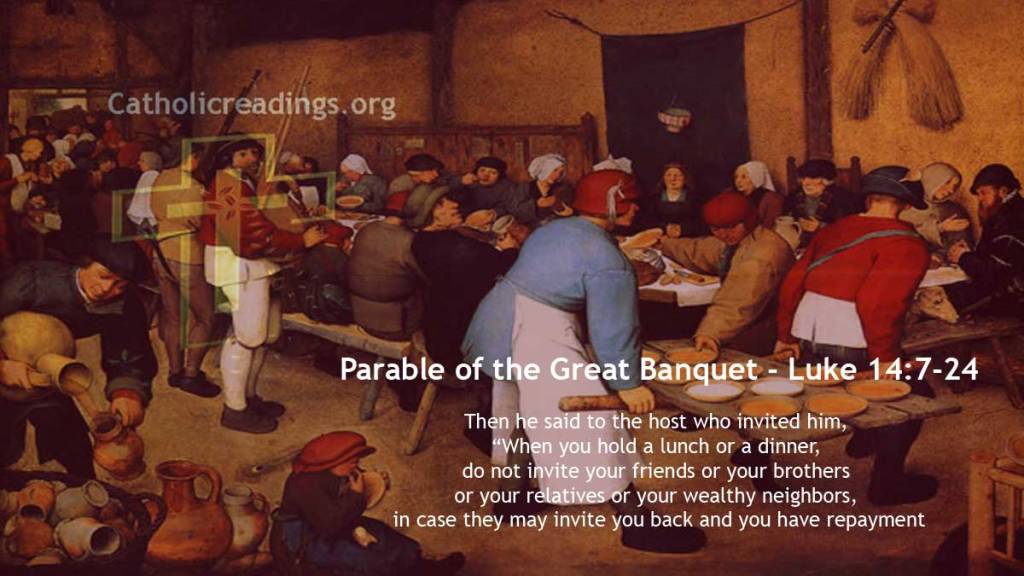
The months of November and December both have great feasts in them, namely, Thanksgiving and Christmas. I happened to hear a video of an excellent talk by a speaker at the summer NAPA conference this year about the importance of hospitality in human relations. The very next day I happened to read the Gospel for that day (November 6th) about the Parable of the Banquet in Lk 14. The meditation in Word Among Us that day was excellent. Not taking this as a mere coincidence, I include that fine meditation below.
Luke 14:12-14
When you hold a banquet, invite the poor. (Luke 14:13)
For Jesus, the dinner table is a sacred place. He often chose to make a personal connection with people by coming to eat at their homes. Because Jesus is present in the sacred meal of the Eucharist, heaven touches earth at every Mass. This holy encounter will continue into eternity in the “wedding feast of the Lamb” (Revelation 19:9).
But even ordinary mealtimes can provide opportunities to meet with God. From Abraham to Rahab to the first disciples, God’s people encountered their Lord by showing hospitality (Genesis 18; Joshua 2; Acts 2:44). Even more, they reflected the generous hospitality of God himself.
So when Jesus talks about holding a banquet and inviting the poor, he’s inviting us to be hospitable like his Father (Luke 14:13). He’s asking us to rework our guest lists and reorient our hearts. He’s asking us to open our arms to the suffering and marginalized and see them with his compassion. And he’s reminding us that people who are poor or suffering have great dignity.
Jesus is not just describing a meal offered, but a meal shared as family. We can truly encounter and connect with another person by welcoming them, by being present and listening, and by experiencing God’s love together. As we sit at such a table, walls begin to tumble. Sharing a meal communicates love in tangible ways that surpass words, and a stranger can become a brother or a sister.
We might not know how to “invite the poor” into our lives, but we can start by asking the Holy Spirit to show us someone who is hungry—whether for food or for an experience of God’s love. The Spirit can open our eyes and help us to reach out to them. People often have simple, ordinary needs. Even a smile or a few dollars or a kind word can open the door to the hospitality God wants us to show. As we talk with them, we may have an opportunity for a longer encounter—perhaps by getting a cup of coffee or inviting them to lunch. There, we will also encounter the God who lives within them. We can affirm the beauty and dignity he has breathed into their souls—and find Jesus himself.
“Lord, open my heart, my schedule, and my table today to someone who is poor or poor in spirit today.”
Bishop Caggiano of the Diocese of Bridgeport delivers an introduction of his vision of The One. This is the first in a series of ten. (4 min)
1. What is the One
In this initial video, Bishop Caggiano gives an introduction to the vision he calls, The One.
Transcript
Auto-scroll
My dear friends, allow me to begin by offering my personal thanks to the two thousand, three hundred individuals who joined me for those nine initial regional meetings, which allowed me to introduce The One.
But since those days, many people in different venues have asked me, well, Bishop, what is The One?
And of course, it’s a question that may not have such an easy answer.
Because one could say it’s an initiative, and in some sense it is, because in the years ahead, we’re going to have an opportunity to offer events and programs and formational experiences, and those are very good. But The One is more than that.
It is certainly a change of culture. I mentioned that in my talks. The hope is, by all that we do together, the accumulated effects of our work will begin to change the culture of our church so that it will create an environment where every person who’s baptized can come to deeply know the Lord, and enter into discipleship for a lifetime, and go out in mission.
But The One is more than that.
And of course, I called it an adventure, and I do believe it is an adventure. Because it’s going to invite real change in your life and mine.
So what is The One?
Perhaps the best to describe it is for me to say: The One is the one invitation being offered to
you and me.
An invitation unlike any other invitation you and I have received.
It’s an invitation to ask with courage a basic question.
What is it that you are truly, deeply, personally looking for in your life?
And the person who’s asking that question needs to come face to face to the one who’s inviting you and me. And that is the Lord Jesus.
The One is really accepting the invitation of Christ, to come to know love, serve, and follow him in our daily lives, together as sisters and brothers united as his body in the world.
So the one invitation is what brings us together. It’s the one invitation that you and I need to make a personal choice about. It’s the one invitation that simply invites us to allow our lives to be transformed, to give us hope, and through us, to a whole broken and confused world. And of course, we’re not the first to be offered that invitation.
Each Easter, we hear the beautiful story of the two disciples on the road to Emmaus.
And in that moment, they were invited to allow Christ to enter into their lives.
And in the weeks ahead, together with these videos, we’re going to explore what that really meant, how that really changed them. Because the same can happen to you and me and to our entire church.
So what is The One?
It’s the invitation to take our lives and allow them to be transformed in Jesus Christ.
So the question I leave you with, are you and I willing to accept that one invitation?
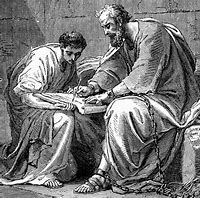
The readings on Monday, September 18th were St Paul’s letter to Timothy (1Tm 2:1-8) and the Healing of the Centurion’s Slave (Lk 7: 1-10). Both passages from Scripture talk about dealing with those that were despised by the Jews at the time, namely, the Romans. In Timothy, Paul encourages the people to pray for those in authority. In Luke, Jesus is speaking with the servants of a Roman centurion. The meditation in Word Among Us provides wonderful insights from these readings and is provided here.
MEDITATION
1 Timothy 2:1-8
I ask that supplications, prayers, petitions, and thanksgivings be offered for everyone, for kings and for all in authority. (1 Timothy 2:1-2)
Jane was frustrated with her boss and often complained about him to others. For as long as she had worked for him, he had never complimented her for her work or given her greater responsibility. One day, a friend suggested that she pray for her boss and ask God to bless him. Jane decided to give it a try, and as she did, she noticed that her attitude toward him began to change. What’s more, she saw an improvement in the way he related to her!
Jane’s experience highlights the same truth that St. Paul wrote to Timothy in today’s first reading: when we pray for others, especially for those in authority, it blesses us as well as them. Paul encouraged Timothy to tell the Christians in Ephesus to pray for everyone—not just other believers, but even for the leaders of the city, unbelievers who held authority over them. Doing so, Paul said, would help the young church to live a “quiet and tranquil life in all devotion and dignity” (1 Timothy 2:2).
When we complain or focus on what is wrong in the world, we can create an air of negativity, not only in our own hearts, but all around us. Without even realizing it, we can bring down our friends, family, or coworkers. But when we pray for people instead, our hearts change. We become more loving, patient, and kind toward them. As a result, our demeanor can help dispel any negativity that we might have brought to the people around us.
So who should we be praying for? If you’re a student, pray for your parents or teachers. If you have a job, pray for your supervisor and the leadership of your company. Pray for the leaders of your town, state, and nation. You don’t have to agree with them on everything—or anything! But you can still pray that God’s blessing and goodness would be upon them. You can still pray that they fulfill God’s purposes for their lives and that they lead as he intended. By doing so, you’re helping to fulfill those purposes. And in the process, you’re softening your own heart.
“Lord, the next time I want to complain about someone, help me to remember to pray for them instead!”
First, I would like to thank Fr. Mecca for initiating this service. The service was held in the church on Friday evening, June 23rd, starting with Adoration at 7 PM. Fr. Sean Kulacz then gave a short presentation about healing followed by the service with four prayer teams. Over 150 people came, and Fr. Sean and his prayer teams prayed over all those who presented themselves for the next 3 hours without a break.
Second, I want to thank all those, both on and off the Committee, who assisted with set-up and during the service. For more information about Healing, Fr. Kulacz and the prayer teams, visit: https://encounterschool.org/fairfieldcounty/.
There will be an Adoration and Healing Service at St Peter Church located at Main St., Danbury on Friday, June 23rd at 7 PM. Laying on of hands (by choice) for healing in body, mind and spirit.
Fr. Sean Kulacz of Holy Family Parish and Encounter Ministries will be here along with his Prayer Teams for Adoration and to perform the Healing Service. All are invited! **Bring a friend along as well.**
This morning’s reading in John’s Gospel 15: 9-15 has the unusual expression that Jesus uses when talking to His disciples. This is part of the Vine and the Branches discourse. The meditation from today’s Word Among Us(May 11, 2023) that follows helps to explain how one might actually do that.
DAILY MEDITATION: JOHN 15:9-11
If you keep my commandments, you will remain in my love. (John 15:10)
We know that we are supposed to love Jesus. But how do we do it? How do you love someone that you can’t touch, see, or hear?
Jesus gives us a simple answer in today’s Gospel: keep his commandments.
Now, we often equate love with passion. But keeping Jesus’ “commandments” is more likely to bring to mind a tedious and demanding list of rules, not deep sentimental or emotional feelings. In fact, it can sound about as exciting as washing a sink full of dirty dishes!
But the truth is, a love that does not include keeping Jesus’ commandments is a love that lacks depth. It’s as if a man were to tell his wife that he loves her but then spend next to no time with her. His words would have little meaning to her, wouldn’t they?
In a similar way, we show our love for Jesus through our actions, especially by the way we love other people. God wants us to treat each other with the same dignity, respect, kindness, and forgiveness that Jesus has for them. As Jesus said immediately after today’s Gospel, “This is my commandment: love one another” (John 15:12).
Loving others doesn’t have to involve grand gestures. We can show our love most clearly in the ordinary ways we serve each other. Volunteering to help out a neighbor with a home improvement project. Helping a child with homework. Caring for a sick spouse. It’s acts like these that show our love and that keep us rooted in Jesus’ love.
Some days it may seem that your acts of love go unnoticed or unappreciated. But God is always pleased with your efforts, even if you can’t see any immediate result. He is using you to bless his people!
So instead of looking at Jesus’ commandments as chores, try thinking of them as your path to joy. Remind yourself that he has given you his command to love “so that my joy might be in you” (John 15:11). You are building his kingdom by your actions—and you are keeping yourself safe in his love at the same time. How could you not rejoice?
“Jesus, teach me to love as you love so that I can know your joy.”








 Seeking Jesus in Danbury