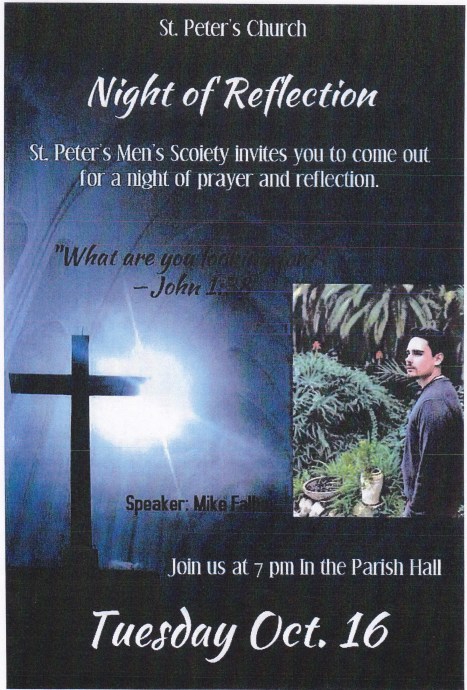
Walking with one another in faith and love.

This year’s Conference is geared to build Christian camaraderie among the men who attend in order that they become more faithful fathers, husbands, brothers, sons and disciples. This is accomplished through presentations and seminars, opportunities for the Sacrament of Reconciliation and for Eucharistic Adoration, and a closing celebration of the Eucharist with clergy from throughout Connecticut. All are invited! Visit: https://ctcatholicmen.org/detailed-overview.
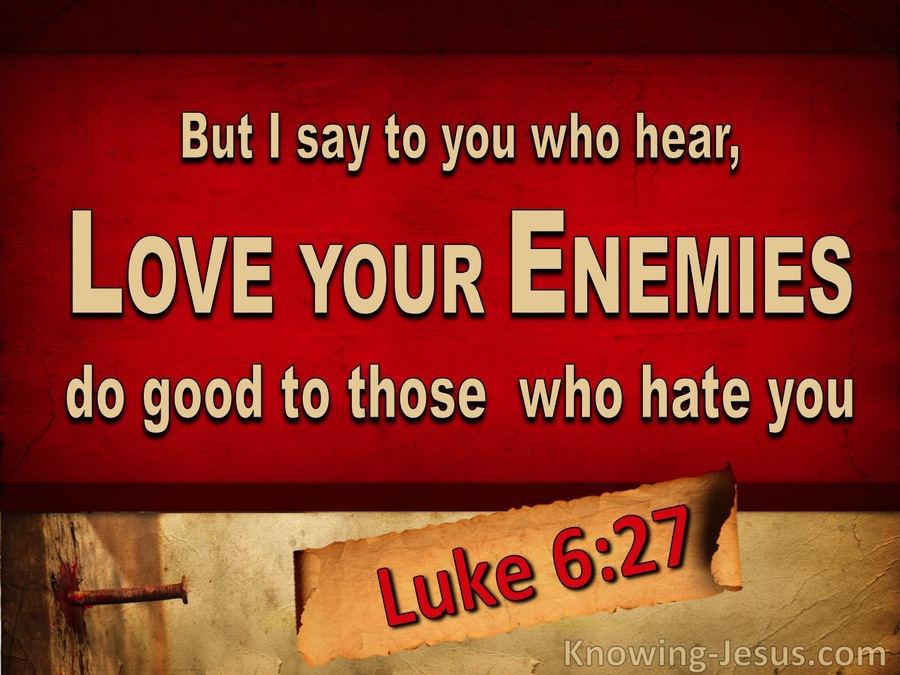
Meditation: Luke 6:27-38
Be merciful, just as also your Father is merciful. (Luke 6:36)
One of the reasons Jesus’ teaching on mercy is so challenging is that we face many opportunities to practice it each day. Like many other challenges, our best defense is a good offense. We are better able to rise to these challenges if we prepare ourselves for them in advance. So what can we do? What attitudes come before mercy?
First there’s love. When Jesus commands us to be merciful, he is essentially telling us to follow the way of love. Love doesn’t seek retribution or “brood over injury”
(1 Corinthians 13:5). That’s why Jesus tells his followers to “bless those who curse you” and “pray for those who mistreat you” (Luke 6:28). So out of love, when a family member says something hurtful, try to hold your tongue instead of lashing out. When someone cuts you off while you’re driving, pray for that person instead of reacting with anger.
There’s also understanding. Pope Francis has said that we are all “a complex mixture of light and shadows” (The Joy of Love, 113). So before you take offense or respond in a negative way, ask yourself, “What might be causing this person to act in this way?” If you step back and take the time to understand a person and the complicated factors that might lead people to do what they do, you may find it easier to be compassionate and thus merciful.
Third, there’s self-awareness. You too are a mixture of “light and shadows.” Yet it’s so very easy to see the plank in a brother’s or sister’s eye but fail to see the beam in your own (Matthew 7:3). When you regularly examine your heart, you are constantly reminded of your own weaknesses. As you become more alert to your own need for God’s compassion and forbearance, it becomes easier to forgive other people and show them mercy.
Because we are a work in progress, we will probably always struggle with the call to be merciful. But how blessed we are that God is merciful to us! As we do our part to prepare our hearts, he will pour out his grace upon us day by day. May we become his face of mercy to all we encounter each day!
“Jesus, grant me the grace this day to show mercy, just as your Father has shown me mercy.”
The Word Among Us
September 2018
Word Among Us is an excellent Catholic publication that I read everyday. This one struck me today.
How does Christian friendship relate to friendship with God?
Susan Klemond
For a decade, Irene and Alyssa shared friendship — as singles, then as newly married women and mothers raising children in a Midwestern Catholic community. But they became close friends only when they also shared their suffering. When Irene was going through a difficult trial more than 15 years ago, she let her guard down and confided in Alyssa. Both women realized they’d been longing for a deeper Christian friendship. (Their names have been changed. They spoke on condition of anonymity.)
Irene said, “It’s higher than just helping someone carry a cross to take their pain as your own. I feel like she does that for me.”
Alyssa agreed: “I think others see that she helps me be a better person. She helped me find the Lord in a moment of despair.”
Bearing one another’s burdens “shoulder to shoulder” is a mark of spiritual friendship, as 12th-century English monk St. Aelred of Rievaulx wrote in his book of the same name.
Drawing on the wisdom of St. Aelred and others, as well as the experiences of Christian friends, what makes a friendship spiritual or Christian? How does it differ from other types of friendship? And how does Christian friendship relate to friendship with God?
Christian friends care for each other, share life and prepare for heaven together. They model virtue and grow in it together, sometimes with a common mission. Unlike other friendships, Christ is a third Person in their cohort, teaching them through his example and their lived experience. As St. Thomas Aquinas said, “There is nothing on this earth more to be prized than true friendship.”
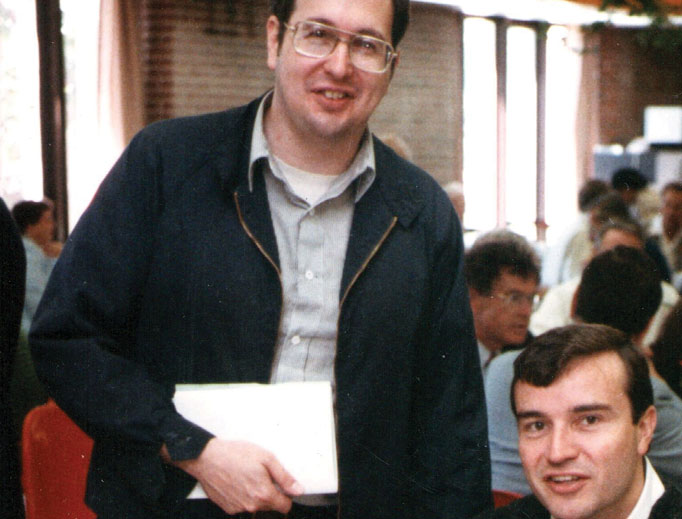
Since they were Jesuit novices in Spokane in 1974, Fathers Robert Spitzer and William Watson shared a love for God and truth, though they often reach conclusions differently. Father Spitzer’s analytical nature and Father Watson’s intuition have proven complementary.
The friends’ vision and love for the truth has strengthened their friendship, said Father Watson, 63, founder and president of Sacred Story Institute in Seattle. “It’s a desire to creatively and in different ways help people access that so they can believe in the Good News.”
Their differences also amuse them. “I might not have missed the 43rd premise in an argument, but I can miss the perfectly obvious,” said Father Spitzer, 65, president of the Magis Center in Garden Grove, California, and host of the EWTN series Father Spitzer’s Universe.
“We definitely appreciate one another’s strengths, and we feel very free to not critique so much as to point to the possible errors of omission in one another’s thinking or, in my case, feeling.”
Christian friends may have complementary gifts, but according to St. Aelred, they must possess loyalty, right intention, discretion and patience, said Redemptorist Father Dennis Billy, a professor at the Mishawaka, Indiana-based Graduate Theological Foundation and staff member at Notre Dame Retreat House in Canandaigua, New York.
Benevolence, actively seeking the other’s well-being and reciprocity also mark Christian friendship, he said.
Friends help each other grow in virtue, and because of virtue, they’re able to share a common purpose in life, said John Cuddeback, a professor at Christendom College in Front Royal, Virginia, who writes about friendship at his blog “Bacon From Acorns.”
God reaches out to us through our human friends to prepare us for divine friendship, Cuddeback explained. “Christ offers us his love through our friends and hoping that friendship leads us back to friendship with him.”
Prayer, spiritual direction and study about friendship can help Catholics seeking Christian friendships, Cuddeback said.
In his Introduction to the Devout Life, St. Francis de Sales advised forming friendships only with those with whom one can share virtuous things. “If your mutual and reciprocal exchanges concern charity, devotion and Christian perfection, O God, how precious this friendship will be!” he wrote. “It will be excellent because it comes from God, excellent because it leads to God, excellent because its bond will endure eternally in God.”
Scripture tells of special friendships Christ had with Sts. John, Martha and Mary Magdalene. Other examples of close Christian friendships include: Sts. Peter and Mark; Sts. Paul and Timothy; and Sts. Gregory Nazianzen and Basil. Of his friendship with St. Basil, St. Gregory wrote: “It seemed that in us there was only a single soul dwelling in two bodies.”
Though they lived in different centuries, Blessed John Henry Newman and Father Henri Nouwen were both theologians and spiritual writers whose close Christian friends deeply affected their lives and helped them grow spiritually.
Cardinal Newman and Father Ambrose St. John were lifelong friends who entered the Catholic Church together in 1845. The friends shared life and were even buried together, a sign some say that their earthly friendship would lead to communion in heaven.
In a sermon entitled, “Love of Relations and Friends,” Cardinal Newman wrote, “The Ancients thought so much of friendship, that they made it a virtue. In a Christian view, it is not quite this; but it is often accidentally a special test of our virtue. … But what is it that can bind two friends together in intimate converse for a course of years but the participation in something that is Unchangeable and essentially Good, and what is this but religion?”
In the 20th century, Father Nouwen had many close friends to whom he wrote thousands of letters.
In his book Love in a Fearful Land: A Guatemalan Story, Father Nouwen wrote, “Friendship has always belonged to the core of my spiritual journey. God has given me many friends, and each of them has played a significant role in my thinking, feeling, thinking and acting.”
These and similar stories are common in good friendships, according to Cuddeback, because “we grow in our ability to live a truly human, and even a truly divine, life together by rolling up our sleeves and holding one anther accountable and striving together.”
Not only do Christian friends know one another, they also look outward — and upward toward God — together, he said.
Fathers Spitzer and Watson share a desire to evangelize. Before establishing their own ministries, they collaborated at two universities, sharing the faith and virtue.
“We not only came alive by giving those students those things, our friendship came alive,” Father Spitzer said. “We were on mission together. Our hearts individually and collectively came alive and made the friendship alive.”
As married women, Alyssa and Irene also share a common mission — caring for their husbands and raising their children in the faith.
Christian friendships ought to “begin in Christ, continue in Christ and be perfected in Christ,” St. Aelred wrote.
Christ-centered friendships resemble a triangle: Each friend has a relationship with Christ, and the bond in Christ’s spirit overflows into their bond with one another, according to Father Billy.
Christian friendship is very much needed, Father Billy said.
“We need to develop in our Church ways to help people look at their relationships and have discretion about whether this is a friendship to invest in.”
Holy, sacred friendship is necessary for those living in the world who want to live in true virtue, St. Francis de Sales wrote. “By this means they encourage, assist and lead one another to perform good deeds.”
Now living in different states, Father Spitzer and Father Watson meet less frequently, but they noted that St. Ignatius, who founded the Society of Jesus, and St. Francis Xavier also were close friends who mostly communicated by letter while St. Francis traveled as a missionary. “We have the kind of friendship that, within a minute of being together, picks up where it left off,” Father Watson said.
Father Spitzer and Father Watson haven’t had new opportunities to tour Montana in a red Pontiac Trans Am, as they did in 2001, but they remain longtime Christian friends on a mission.
Said Father Watson of his Christ-centered friendship with Father Spitzer: “We both know the One who makes everything work.”
Susan Klemond writes from
St. Paul, Minnesota.
National Catholic Register



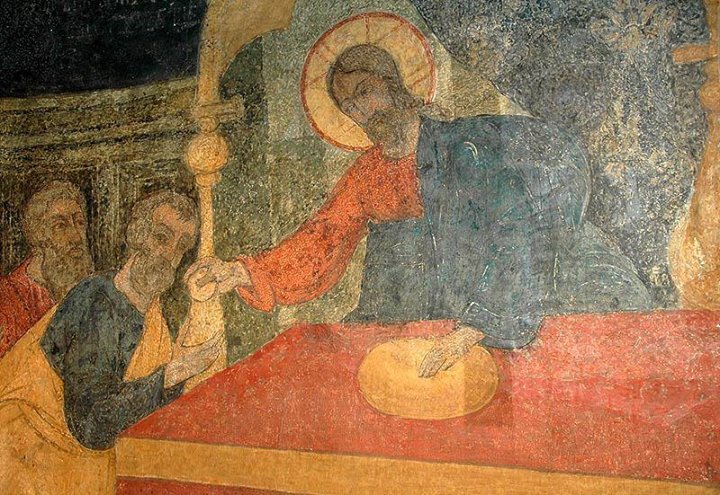
The Living Bread is our August topic. Scripture has been bringing us into this mystery through recent Gospel readings. Since we can never exhaust the mystery of the Eucharist, we will be reflecting on this extraordinary gift.
Join spiritual director, Yvette Lessard, on Thursday morning, August 9th at 10 – 11:45 AM in the Parish hall of St Peter Church on Main Street in Danbury, CT. All are invited to be with us.
I had the great pleasure of watching this film on EWTN last weekend. An excellent film!
A modern and very human take on the story of St. Ignatius of Loyola, the founder of the Jesuits, often called ‘The Saint of Second Chances.’ As a brash, hot-headed soldier in a time of political upheaval in Spain, the young Iñigo went from living a life of brutal violence and debauchery, to becoming one of the greatest saints in the history of the Church. This film chronicles Iñigo’s torturous struggle to turn from darkness to light—a struggle that nearly destroyed him, but also gave him the key to a spiritual weapon that continues to save lives to this very day.
Produced by Jesuit Communications Philippines (JesCom), Ignatius of Loyola was shot on location over two months in Spain. It is an incisive and thrilling look at the life of the real man behind the legend. In his lifelong quest to become the heroic Knight of his fantasies, Ignatius stares death in the face again and again, having his leg shattered by a cannonball in battle; driven to near suicide by his inner demons; finding himself imprisoned, accused of being a member of the Illuminati; and finally finding his life in the hands of the Inquisition. Through it all, he would come to see the hand of God working in his life, shaping the self-obsessed sinner into the loyal and passionate soldier-saint.
The film also shows how Ignacio wove the trials, errors, and lessons of his eventful life into the fabric of his masterpiece, the Spiritual Exercises. Combining clarity of thought with Ignacio’s own love of fantasy and imagination, the Exercises form a rigorous method of making one’s life decisions, and have guided and influenced countless seekers throughout history. Available on DVD.
 It’s About (Space) Time Google Did Something Like This!
I don’t ask for everyone in the world to love Catholics and the Catholic Church. That would be a great Christmas present, I’d admit, but hardly something I’m going to write Santa about. Christ warned us that people would hate us (John 15:18-25) and I’ve steeled myself against that eventuality. Lord knows I’ve had enough practice dealing with the unrepentantly ignorant thus far.
What I ask for, or rather, what I demand, is the truth.
If you’ve got a gripe against the Catholic Church―and it’s legitimate―take a number and stand in line. Today’s not the day we’ll be dealing with your issues. And tomorrow doesn’t look good either.
If someone in their self-inflicted ignorance insists that the Catholic Church is somehow “anti-science,” they prove beyond a shadow of a doubt they’ve never read a book on the history of science. I know this for a fact as on several occasions, I’ve literally handed such books to fundamentalist atheists who’ve literally dropped them to the ground without even bothering to look at their covers, let alone peruse their contents.
And for this reason, I’m extend my warmest thanks and gratitude to Google for finally pointing out a pro-Catholic truth rather than ignoring or actively offending us. Admittedly, on Dec. 17, 2015, Google published one of their Doodles (a temporary interactive logo replacing the normally logo on their home screen) honoring the 245th anniversary of Beethoven’s baptism―yes, he was Catholic. Is anyone truly surprised?
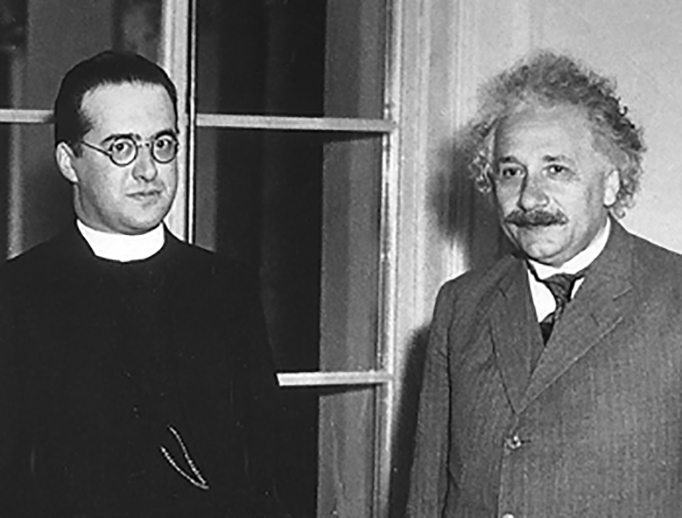
Apparently, a few days ago, on July 17, Google honored Fr. Georges Lemaître with yet another Doodle. Fr. Lemaître was the Belgian physicist who came up with the Big Bang Theory without which, we would never have had a fun, interesting title for one of CBS’ best, recent comedies.
July 17 was the 124th anniversary of Fr. Lemaître’s birth.
As Google wrote on their home page:
Most people have heard of the Big Bang theory, but fewer recognize the name Georges Lemaître, the man who came up with the hypothesis that transformed our understanding of astrophysics. Born on this day in 1894, Lemaître was a Belgian Catholic priest who proposed that the universe began as a single primordial atom, which he referred to as the ‘Cosmic Egg.’
Google further correctly pointed out that:
Although [Fr. Lemaître’s] thesis was based on calculations derived from Einstein’s theory of general relativity, Einstein initially dismissed Lemaître’s work, remarking, ‘Your calculations are correct, but your physics is atrocious.’ [“Vos calculs sont corrects, mais votre physique est abominable”] Two years later Einstein changed his mind.
Fr. Lemaître proposed a currently expanding universe, which explains the redshift of galaxies. From this, he extrapolated an initial “creation-like” event must have occurred. In the 1980s, Alan Guth and Andrei Linde modified this theory by including their Theory of Inflation. Unlike Fr. Lemaître’s theory, inflation is no longer considered a serious scientific theory and has been relegated to the dustbins of intellectual history.
In 1931, Fr. Lemaître published an article in Nature describing his theory of the “primeval atom.”
In 1933, at the California Institute of Technology, after Lemaître explained his theory, Einstein stood and applauded and is reported to have said, “This is the most beautiful and satisfactory explanation of creation to which I have ever listened.”
The title in the scientific journals that day read, “Atheist Einstein Eats Crow Catholic Priest Serves Up!”
Fr. Lemaître studied at the Collège du Sacré-Coeur, in Charleroi, a Jesuit school (not a surprise) and then at the prestigious Catholic University of Leuven then joined the diocesan seminary. He served a stint as an artillery officer in the Belgian army during World War I. He won a scholarship to Cambridge University and, upon graduating, studied at Harvard and earned his doctorate in physics at the Massachusetts Institute of Technology.
In 1946, he published his book entitled L’Hypothèse de l’Atome Primitif (The Primeval Atom Hypothesis).
In 1951, Pope Pius XII’s exuberance for Fr. Lemaître discovery led the pontiff to the conclusion that the priest had discovered scientific proof of the Genesis creation account and for Catholicism in general. Fr. Lemaître, on his part, demurred, saying, “As far as I see, such a theory remains entirely outside any metaphysical or religious question. It leaves the materialist free to deny any transcendental Being,”
This enigmatic rebuttal is often bandied about to belittle Fr. Lemaître’s universe-shaking (literally) paradigm. However, it’s often misinterpreted. If a “Big Bang” could not be pointed out in the history of the universe, it could be said that this would refute the Genesis account. As Fr. Lemaître correctly identified the universe’s origin, though the materialist is free to deny any transcendental Being, he would be foolish to do so.
However, even the most careful examination of the relevant passage shows the Big Bang is referred to in Scriptures:
In the beginning, when God created the universe, the earth was formless and desolate. The raging ocean that covered everything was engulfed in total darkness, and the Spirit of God was moving over the water. Then God commanded, ‘Let there be light’—and light appeared. (Genesis 1:1-3)
Fr. Lemaître was hardly the first Catholic cleric scientist and he wasn’t the last. But he, of all of our scientific minds remains the biggest fly in the atheist’s chardonnay. They can only insist that the Catholic Church is “anti-science” only if they ignore all history and science books which, unsurprisingly, they do with a great eagerness and fear.
Tellingly, the term “Big Bang” was first used during a 1949 BBC radio broadcast in which atheist astronomer Fred Hoyle dismissed Lemaître theory. Hoyle remained a proponent of the junk science “Steady-State Theory” of the universe and remained so until his death in 2001.
Fr. Lemaître died on June 20, 1966, two years after having learned of the discovery of cosmic microwave background radiation. This must have warmed the cockles of his Catholic heart as this was crucial evidence for his Big Bang theory.
His theory was further confirmed in the 1990s through observations of distant Type IA supernova with the Hubble Space Telescope.
And for all his troubles, Fr. Lemaître now has a lunar crater named after him―not too shabby considering they just don’t just give those out willy-nilly. In addition, minor planet 1565 Lemaître was named after him. (Take that, Pluto and Neil DeGrasse-Tyson!)
Fr. Lemaître was always a proponent of both science and the Catholic Church which he said offered the same truth but from different, and complimentary, perspectives. After all, if it is true, then it must be God’s Truth.
God bless, Fr. Lemaître. If I get to Heaven, I’d like to shake your hand.
 Seeking Jesus in Danbury