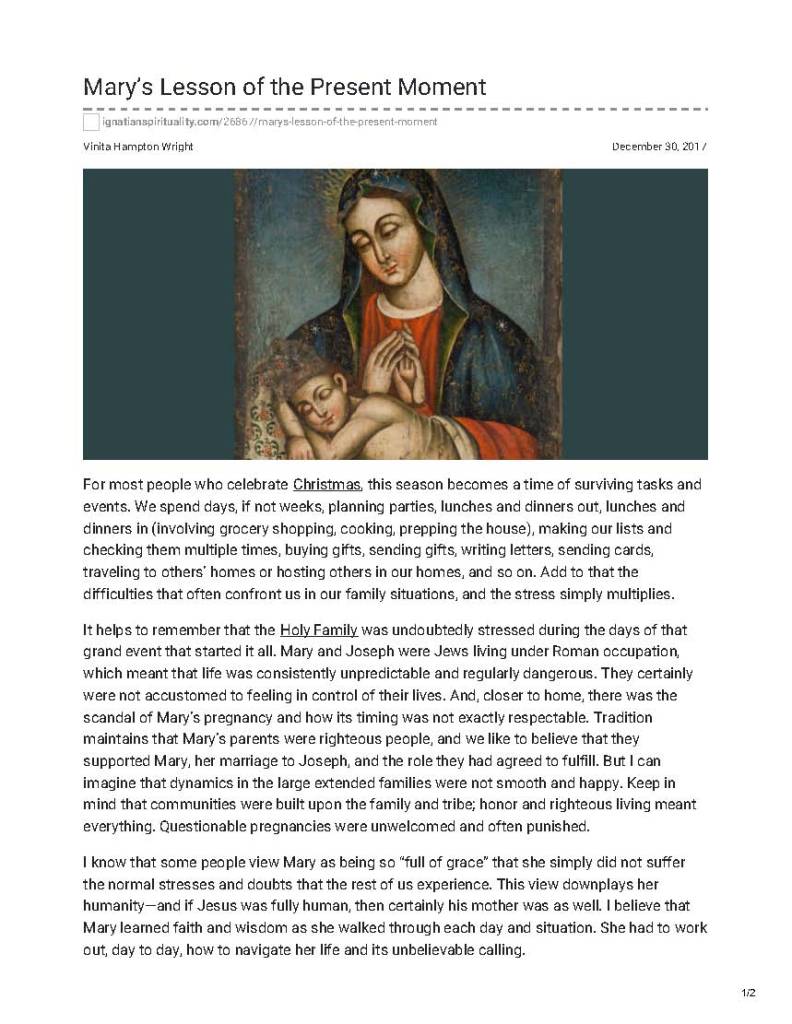
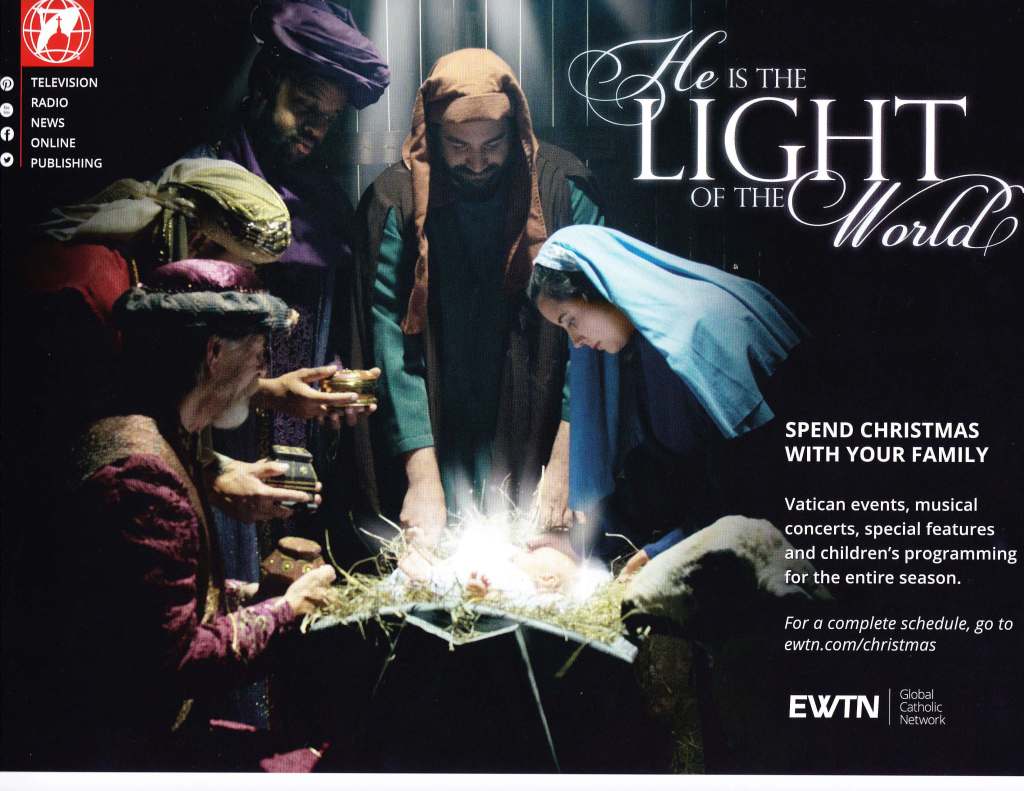
#ChristmasSpirit
Walking with one another in faith and love.


#ChristChild
#Nativity
L
COMMENTARY
Edward Sri
Two words about Mary from the Bible describe most of our lives in December: “in haste.”
We run in haste to the mall, post office and grocery store. In haste, we rush to office parties and pageants.We pack the bags and the car, or race to get the house clean and ready.
There are only 24 days in the month to fit everything in, soall must be done with haste. While the month of December has moments of joy, for many, words like “stressed” and “overwhelmed” more adequately describe the norm.
But if there were ever a woman who had an excuse for feeling overwhelmed and needing to be “in haste” in the days leading up to Christ’s birth, it would be Mary.
No Pressure?
Think about all she had on her shoulders. The angel Gabriel just announced that she’s having a baby. That alone would be big news! But Gabriel goes on to tell her that this baby will be not any ordinary child, but the Prophesied One — Israel’s long-awaited Messiah-King. And that’s not all: Mary will conceive this child not by natural means, but as a virgin through the power of the Holy Spirit. There’s never been a conception like that before! Her child will be the holy Son of God.
That’s a lot to take in from one short conversation with an angel. It’s fair to say Mary has a lot going on in her life in the days leading up to Christ’s birth. Even if she were living by today’s standards, everyone would have understood if she didn’t get Christmas cards out that year or if her house were not spotlessly clean or the gifts arrived late in the mail.
Still, Luke’s account of the Visitation reveals that, even with all she’s now responsible for, Mary doesn’t turn in on herself. She remains focused on God and on other people in the midst of the sudden turn of events in her life.
Mary’s Eagerness
After hearing the angel’s astounding message, Mary goes “inhaste” to the hill country of Judea to serve her elder kinswoman Elizabeth during her pregnancy with John the Baptist and to share in the joy over all that God is about to accomplish in Israel (Luke 1:39).
I know when I have much to do I’m not always like Mary. I can be tempted to close in on myself — focusing on my projects, my problems, my concerns — and not be as attentive to those around me. But Mary was not like that. Luke informs us that right after receiving this message, Mary goes “in haste” to serve Elizabeth.
This particular phrase can be translated as “with thoughtfulness” or “with eagerness,” which may get more to the heart of the matter. She’s eager to help Elizabeth; eager to be with her cousin. She does not allow herself to be so “busy” and “overwhelmed” that she misses out on what matters most: the people in her life and her relationship with God.
What Matters Most
A young girl woke up on Christmas Eve excited to come downstairs and share this special day with her mom. Only one more dayt ill Christmas! But Mom was in a flurry of activity, cleaning, cooking, baking and wrapping.
Relatives were coming to town for the annual Christmas Eve dinner, and there was a lot of pressure to have everything just right. There was no time that morning to play with her daughter, read stories and make the Christmas cookies as she had hoped.
“Maybe this afternoon after I get everything ready,” the mom told her daughter. But the day quickly passed, and Mom was still too overwhelmed. Each time the child asked for some attention, the mom increasingly got frustrated. “Things aren’t ready yet — you’ll just have to wait!” she said with a stressed-out tone of annoyance.
But when snow started falling and she noticed her daughter staring out the window with tears in her eyes, the mom stopped what she was doing.
She took off her apron, put on her coat and boots and spent the rest of the afternoon playing in the snow with her daughter.
When the guests showed up two hours later, things were not as prepared as she had hoped. She never got to that second dessert she was hoping to make. And there were several rooms left unvacuumed. She didn’t have time to set out the nice china, and some of the last-minute presents had to be placed into gift bags instead of being wrapped. It was not a failure for a Christmas Eve dinner, but it certainly was far from her best performance. She only got a “B-minus” on her hosting that night, in her estimation. But in the end, she got an “A” on what matters most — spending time with her child.
This Advent season, we all will run “in haste.” But the crucial question God is asking us is this: Will we run in haste after what matters most?
Will we run in haste to truly encounter the people in our lives? To make time to talk to them? To take time to listen to them?
Will we run in haste to the chapel, to visit Jesus in the Blessed Sacrament? Will we run in haste to Mass? Will we run in haste to make sure we have quiet time each day for prayer — to be like Mary, keeping and pondering the mystery of the Advent season in our hearts?
Edward Sri is a theologian, author and speaker.
His newest book is Rethinking Mary in the New Testament (Ignatius Press).
More about his work can be found at EdwardSri.com.
Published by National Catholic Register Dec. 2018
#AdventCatholic
#Advent
St Peter Church, Danbury, CT – Sunday, Dec 9 at 3 PM
Festival of Nine Lessons and Carols.
The Festival of Lessons and Carols tells the story of the fall of humanity, the promise of the Messiah, and the birth of Jesus in nine short Bible readings from Genesis, the prophetic books and the Gospels. Christmas Carols are interspersed between the readings. The congregation is invited to join in singing some of the more familiar Carols. This year, our Adult Parish Choir will be joined by the Children’s Choir and our newly established Nelly Goletti Choristers. There will be almost 50 choir members of all ages praising God for the gift of the Incarnation and our Redemption in Jesus Christ. All are invited to this festive liturgy! A punch and cookie reception will follow in the parish hall. – Glenn Segger, MusicMinister, #Advent #AdventCatholic


The revelation of Jesus Christ. (Revelation 1:1)
Have you ever wondered what the Book of Revelation is about? You’re not alone. This book has baffled, bedeviled, and frightened readers for centuries. That’s mainly because the Book of Revelation is a different kind of writing that we’re not too familiar with in the twenty-first century.
Revelation is a prime example of “apocalyptic” literature. That means it uses dramatic imagery—cosmic signs and fanciful creatures—to interpret present-day events. In the case of this book, it is an interpretation of the readers’ own challenging situations: persecution, false gospels, complacency, and general hardship.
But that’s only one part of the picture. The overall goal of Revelation is to reveal Jesus himself, the One whose kingdom can withstand any challenge or hardship. It’s an unveiling—a throwing back of the curtain around heaven.
From now until Advent begins, the Church’s liturgy will feature readings from this beautiful but puzzling book. These readings will unveil a truly awe-inspiring Jesus. You’ll see him take his throne on a seat of glory. You’ll see him surrounded by myriads of worshippers crying, “Holy, holy, holy” (Revelation 4:8). You’ll even hear him speaking from heaven as he tells you that he has come, not only to destroy the old reign of sin, but also to “make all things new” (21:5).
For the next two weeks, begin each prayer time by asking the Holy Spirit to open your eyes so that you can see Jesus in the passages you will read. Then read through them. Don’t be afraid to use your imagination. Go ahead and picture the scenes. Imagine yourself actually in them. Let those pictures draw you into worship. If you find yourself struggling amid unfamiliar signs and symbols, that’s okay. See if you can find a commentary in your Catholic study Bible that might clarify these images for you. Footnotes can provide context or help you understand what the images mean.
Finally, trust that God is going to bless you. After all, he said, “Blessed is the one who reads” (Revelation 1:3)! Let this fantastical imagery help you imagine Jesus’ majesty. Let it convince you that no matter what life throws your way, Jesus is on his throne and in control.
“Holy Spirit, open my eyes to see the glory of Jesus.”
#UnderstandRevelation
#StPetersDanbury
Published by Word Among Us – 19November 2018
I sat at the kitchen counter, twirling a pen, my calendar open before me. I was determined to find a way to create some more order to my time and my life. In the early days of finally having all six of my children in school, I had already noticed that rather than more time, […]
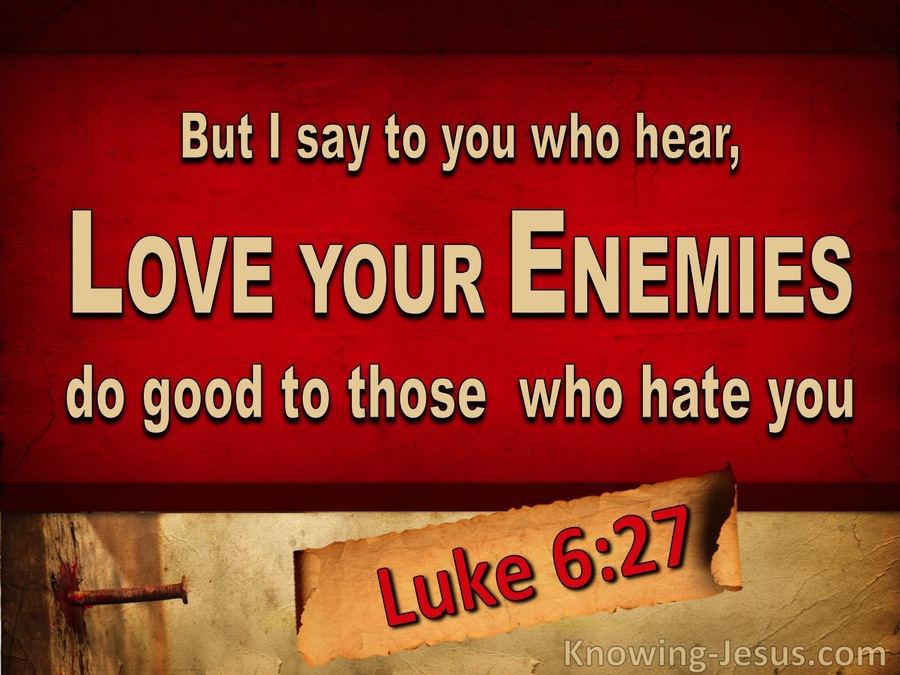
Meditation: Luke 6:27-38
Be merciful, just as also your Father is merciful. (Luke 6:36)
One of the reasons Jesus’ teaching on mercy is so challenging is that we face many opportunities to practice it each day. Like many other challenges, our best defense is a good offense. We are better able to rise to these challenges if we prepare ourselves for them in advance. So what can we do? What attitudes come before mercy?
First there’s love. When Jesus commands us to be merciful, he is essentially telling us to follow the way of love. Love doesn’t seek retribution or “brood over injury”
(1 Corinthians 13:5). That’s why Jesus tells his followers to “bless those who curse you” and “pray for those who mistreat you” (Luke 6:28). So out of love, when a family member says something hurtful, try to hold your tongue instead of lashing out. When someone cuts you off while you’re driving, pray for that person instead of reacting with anger.
There’s also understanding. Pope Francis has said that we are all “a complex mixture of light and shadows” (The Joy of Love, 113). So before you take offense or respond in a negative way, ask yourself, “What might be causing this person to act in this way?” If you step back and take the time to understand a person and the complicated factors that might lead people to do what they do, you may find it easier to be compassionate and thus merciful.
Third, there’s self-awareness. You too are a mixture of “light and shadows.” Yet it’s so very easy to see the plank in a brother’s or sister’s eye but fail to see the beam in your own (Matthew 7:3). When you regularly examine your heart, you are constantly reminded of your own weaknesses. As you become more alert to your own need for God’s compassion and forbearance, it becomes easier to forgive other people and show them mercy.
Because we are a work in progress, we will probably always struggle with the call to be merciful. But how blessed we are that God is merciful to us! As we do our part to prepare our hearts, he will pour out his grace upon us day by day. May we become his face of mercy to all we encounter each day!
“Jesus, grant me the grace this day to show mercy, just as your Father has shown me mercy.”
The Word Among Us
September 2018
Word Among Us is an excellent Catholic publication that I read everyday. This one struck me today.